
By the owner of Demboys Marine Detailing · October 5, 2026
Gelcoat restoration means cutting the oxidation out of the gelcoat with liquid compounds and high-speed rotary polishers, then refining the surface until the color and gloss come back. Sun, salt, and skipped waxing turn a hull chalky. A proper cut reverses that. A coat of wax on top does not.
Owners from Jupiter through Palm Beach Gardens, Boca Raton, and Fort Lauderdale usually ask about price first, in plain terms: how much does it cost to make a boat shine again? The honest answer is a range. It moves with the boat’s length, how much surface there really is, how oxidized the gelcoat is, and how the boat sits: on a lift, on a trailer, or in the water at a float. The figures below are typical South Florida market ranges for a complete job. They are not a quote for your boat.
How much does it cost to make a boat shine again?
For a boat between 20 and 40 feet, bringing the shine back in South Florida typically runs about $1,380 to $3,600 for a polish with a full detail, about $1,800 to $5,500 for a two-step heavy cut, and about $4,500 to $8,500 or more if the gelcoat needs sanding. Which one you need depends on how oxidized the gelcoat is, not just how long the boat is.
Only need the topside, from the rub rail up? Expect roughly 25 to 40 percent less than the full-boat ranges below.
A complete job also includes a full detail of everything the compound dirties: seats, metal, mold, and rust. Compound dust lands everywhere, and a boat is not finished until it is cleaned up.
What changes the price
Length is only a rough guide. A 35-foot boat is more than a little more work than a 30-foot boat. Hardtops, window frames, compartment lines, dashes, and hull sides all add surface, and on a two-story yacht five extra feet can mean a much larger hull and far more compartments.
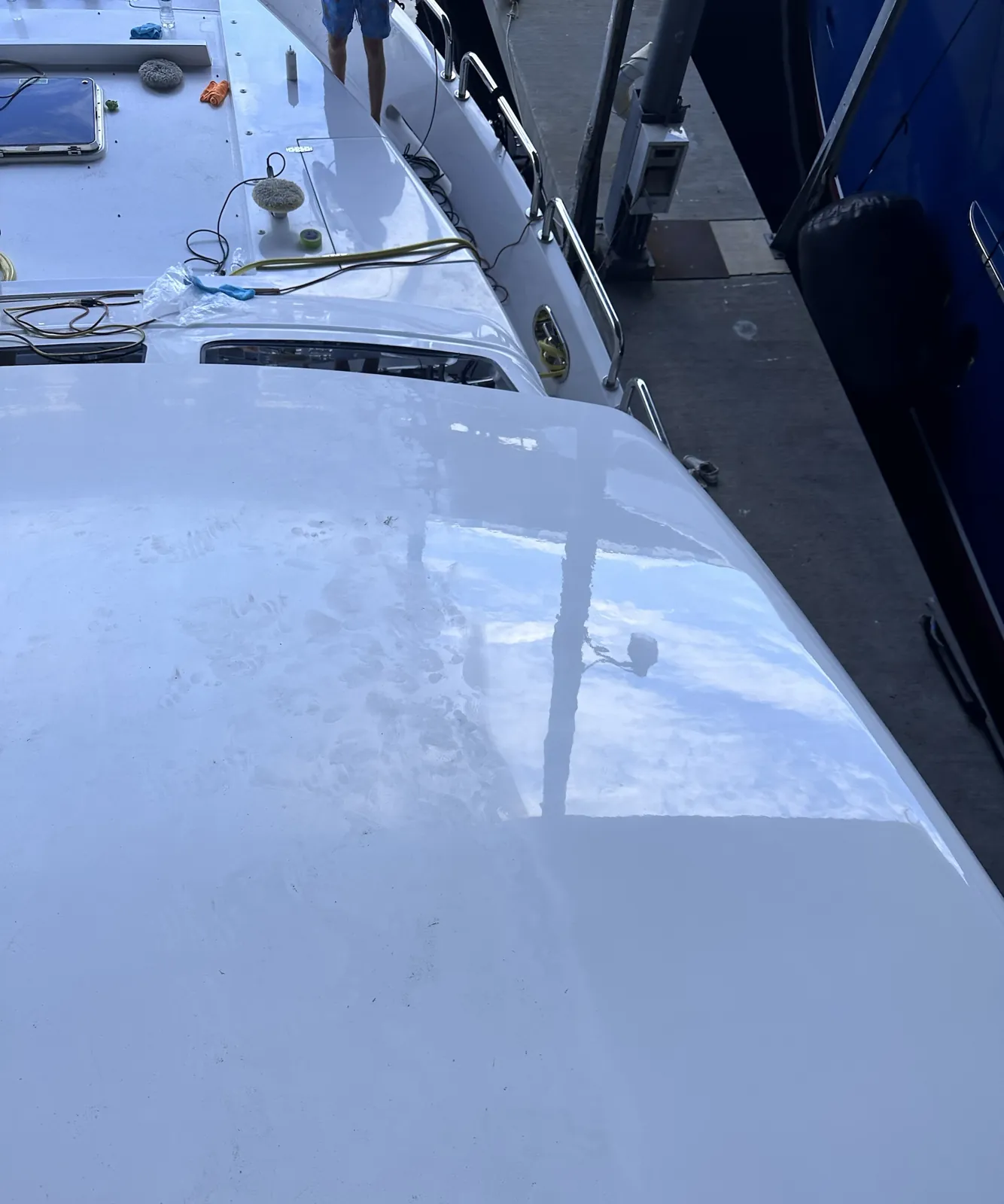
Oxidation decides the process. Light chalk can often be polished out. Heavier chalk needs a cut and a refining step. If a boat has gone a long time without wax, the compartment lines, the underside of the hardtop, and the dash need correction too. Those areas are part of the job, not an add-on.
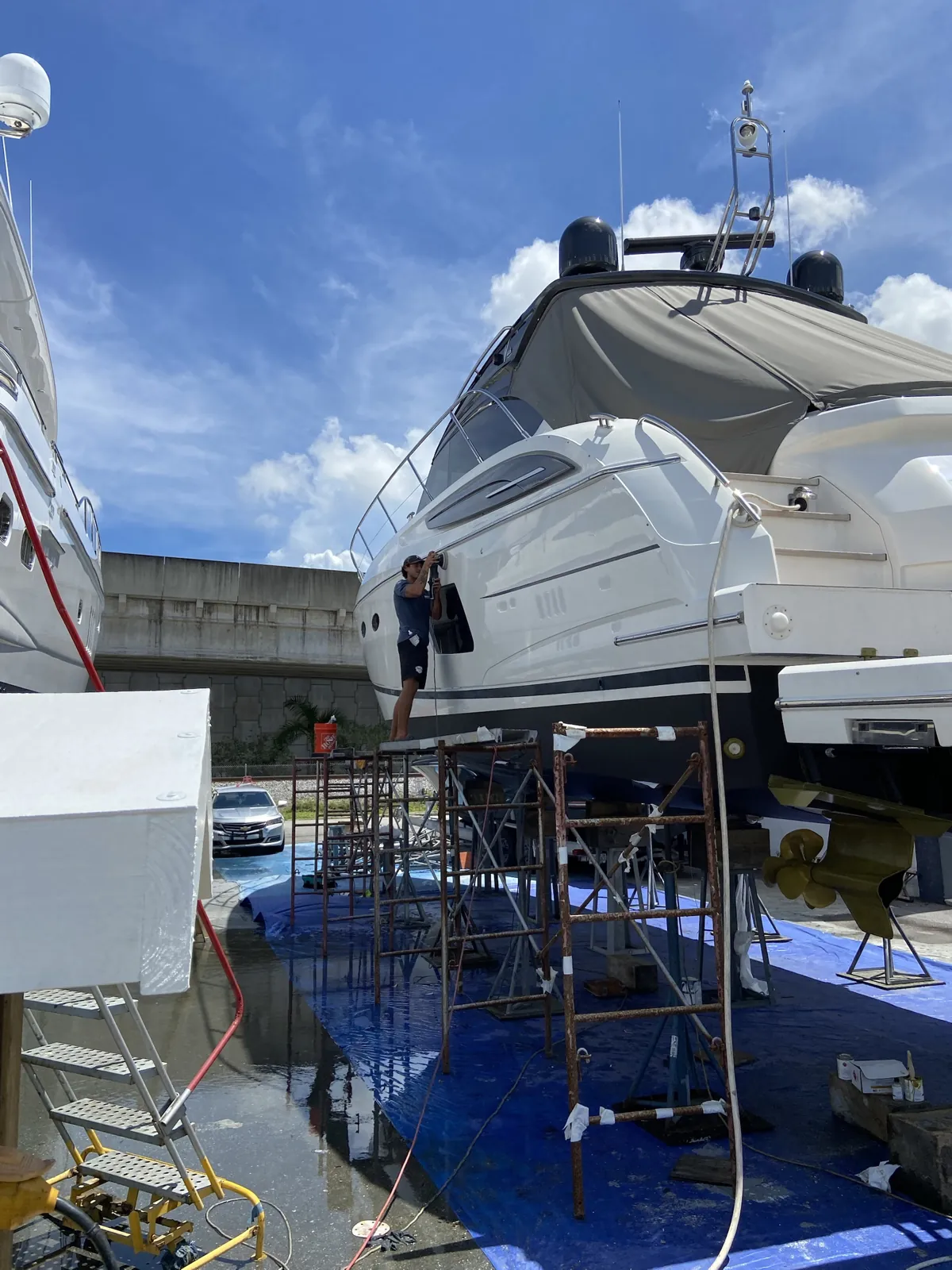
Access changes the labor. A boat on a lift is a different job from one worked off a float, and a large smooth hardtop is a big, visible panel. Curves and tight lines add time even when the boat’s listed length looks modest.
Be careful with a bid that is far below the rest. A lower price can mean fewer passes, and the oils in some compounds and waxes can hide leftover scratches for a few weeks. The boat looks finished until the next stretch of sun.
You can check where your boat stands before you call anyone. Shine a bright, direct light into the gelcoat. No reflection means sanding. A little reflection and a chalky feel means a two-step cut and polish. A dull reflection with a smooth feel means a polish. The full check is in When Is Compound Needed?.
Light oxidation: polish, then a full detail
Light oxidation can usually be polished out with less labor. The job still includes a full detail wash and wax, because the compound has to come off the whole boat, not just the panels that were polished.
| Boat length | Typical South Florida range |
|---|---|
| 20–30 ft | $1,380–$2,600 |
| 30–40 ft | $2,000–$3,600 |
The low end assumes straightforward access and mostly flat, reachable panels. The high end shows up on a lift, off a float, on a large hardtop, or when there is more surface than the length suggests.
That level of work is what the polish service on this site describes: smooth gelcoat on the topside and hull, plus a detailed wash and wax. Polish from the waterline down and underneath the hardtop are not part of a standard polish.
Heavy cut: two-step correction
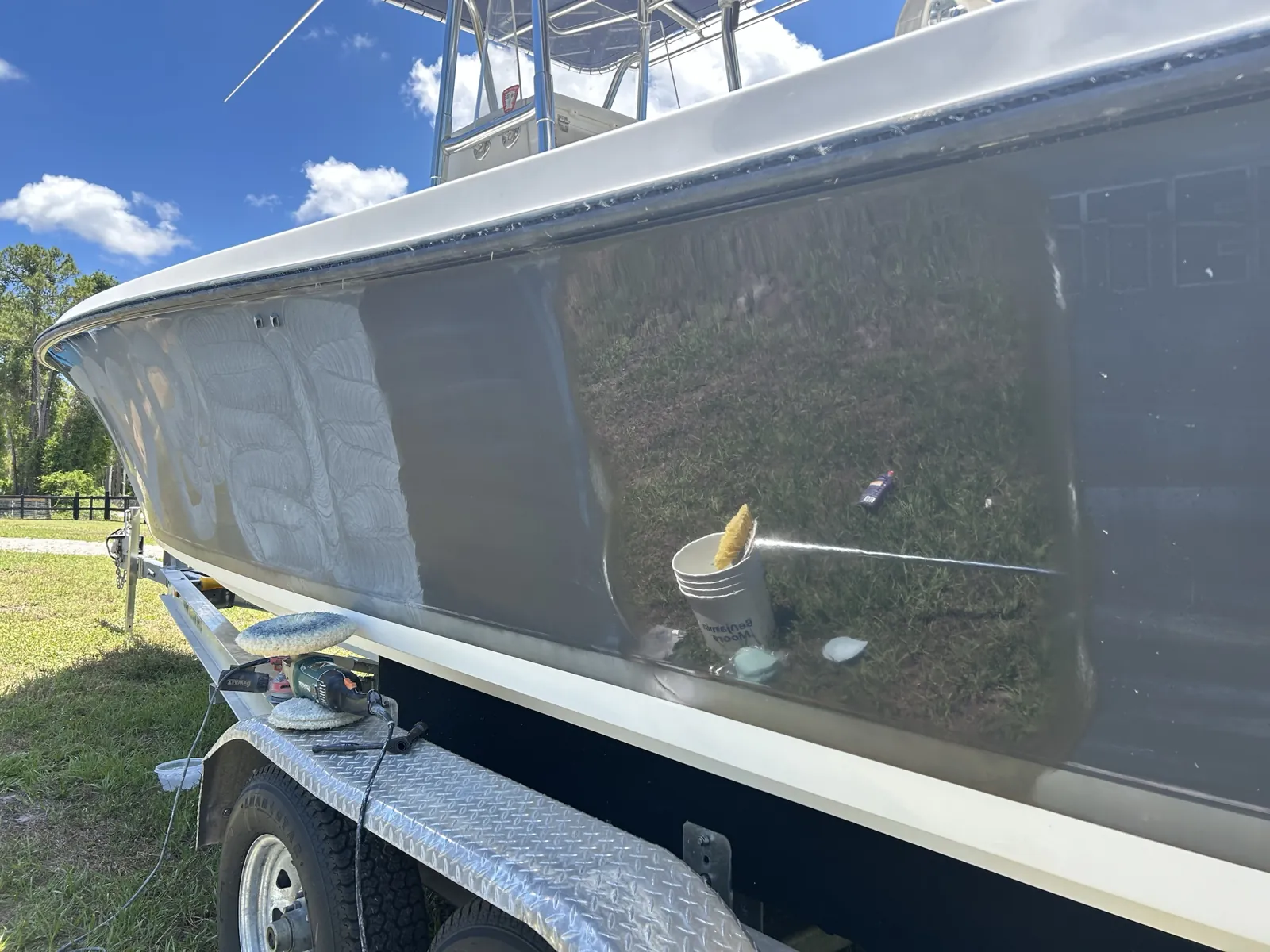
A heavy cut is slower. More of the boat needs correction, including lines and panels that were skipped for years.
| Boat length | Typical South Florida range |
|---|---|
| 20–30 ft | $1,800–$3,600 |
| 30–40 ft | $3,300–$5,500 |
A 30- to 40-foot two-step often lands around $4,200–$5,500 when access is awkward or the oxidation is widespread. A simpler hull can come in closer to $3,300–$4,300. Same rule: these are market ranges, not a menu price.
Seats, metal, mold, and rust still need finishing after compounding. They are part of the job, not a separate upsell.
Sanding correction
Sanding is not a heavier polish. It is a surface repair. Sanding marks in gelcoat only disappear after several passes of heavy cut, until the surface is actually smooth. If those passes are skipped, the boat can look fine the day it is finished and haze soon after. It will also oxidize faster, because the scratches hold salt, dirt, and other contaminants.
| Boat length | Typical South Florida range |
|---|---|
| 20–30 ft | $4,500–$6,000 |
| 30–40 ft | $6,500–$8,500, sometimes more |
There is no license or certification that guarantees a detailer can sand gelcoat safely. Before you pay for a full sanding correction, ask for a test spot. Have the detailer put a light on the work, wipe it with alcohol, and look at it with you. If the spot hazes, or scratches still show under the light, the rest of the boat will do the same.
A careful detailer will also tell you which areas will not come out, no matter how many passes are made. Perfecting those spots can take a different process that may not be worth the money. Be wary of any promise that every panel will look new, because gelcoat has limits.
What a large yacht does to the number
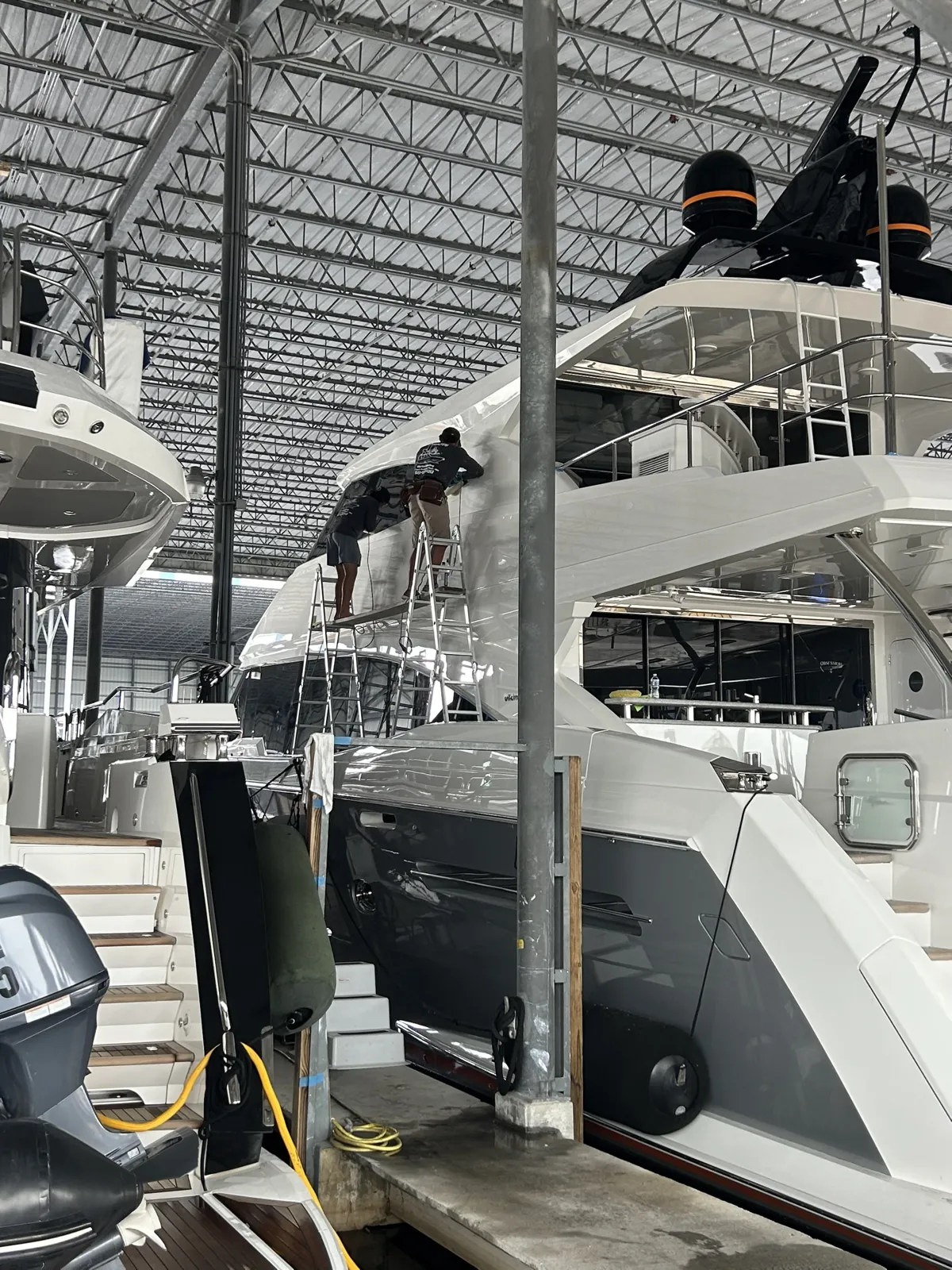
On a roughly 100-foot, two-story yacht, the surface area stops scaling with length. These figures assume the crew handles the interior detail and the outside scope is gelcoat work only. If the same crew is also expected to detail seats, metal, and the rest of the exterior, the number moves again.
| Process on a ~100 ft yacht | Typical range, gelcoat work only |
|---|---|
| Polish | $10,000–$13,000 |
| Two-step cut and polish | $20,000–$25,000 |
| Sanding correction | $50,000–$80,000 |
How to read a quote
A useful quote names the process (polish, two-step, or sanding), the panels included, and anything that will not come out. It includes the detail work compounding makes necessary, and it is tied to where the boat sits and how oxidized it is, not to length alone.
Compare the scope before you compare the price. The cheapest bid on a sanding job deserves the most questions.
Prices in Palm Beach Gardens, the rest of Palm Beach County, and South Florida move with the season, access, and the condition of the gelcoat on the day the boat is seen. Treat every figure here as a planning range. The only number that applies to your boat is a written quote after someone has looked at it.
What to do if you have not waxed your boat in a while
Start with the light test above, before you buy anything. If the gelcoat still reflects and feels smooth, it is not oxidized yet, and a wash and wax is the right next step. If it looks dull or feels chalky, wax will not bring the shine back, because wax protects gelcoat that is already corrected. That boat needs a polish, a two-step cut, or sanding first, and the wax goes on after. Once the boat is protected again, plan on a wax about every 3 months on the water, or about every 6 months in dry storage. The schedule is covered in How Often Should I Wax My Boat?.
Service definitions for polish, heavy cut, and sanding are on the services page.
FAQ
How much does it cost to make a boat shine again?
For a 20 to 40 ft boat in South Florida, a polish with a full detail typically runs about $1,380 to $3,600, a two-step heavy cut about $1,800 to $5,500, and sanding correction about $4,500 to $8,500 or more. These are market ranges, not a quote, and the oxidation on the boat decides which one applies.
How much does gelcoat restoration cost in South Florida?
A light polish with a full detail wash and wax typically runs $1,380–$2,600 on a 20–30 ft boat and $2,000–$3,600 on a 30–40 ft boat. A two-step heavy cut typically runs $1,800–$3,600 and $3,300–$5,500 for those same lengths. Sanding correction typically runs $4,500–$6,000 and $6,500–$8,500 or more. The boat, the access, and the oxidation change the number.
How much cheaper is it to detail only the topside of a boat?
A topside-only detail, from the rub rail up, typically runs about 25 to 40 percent less than the full-boat ranges in this article.
What should I do if I have not waxed my boat in a while?
Shine a bright, direct light into the gelcoat. If it still reflects and feels smooth, a wash and wax is the right next step. If it looks dull or chalky, wax will not fix it. The boat needs a polish, a two-step cut, or sanding first, and then wax.
Is a cheap gelcoat quote a better deal?
Not by itself. A lower price can mean fewer passes, and compound oils and wax can hide leftover scratches for a few weeks. Compare what each quote includes, not only the price. On a sanding job, skipped passes haze quickly and oxidize faster.
How do I know if my boat needs polish, a heavy cut, or sanding?
Shine a bright, direct light into the gelcoat. No reflection means sanding. A little reflection and a chalky feel means a two-step cut. A dull reflection with a smooth feel means a polish.
Should sanding include a test spot?
Yes. There is no license that guarantees the work. Ask for a test spot, a light on the panel, and an alcohol wipe before the rest of the boat is sanded.
More from the blog
- How to Not Hire Us: 3 Tips to Extend Your Wax
- When Is Compound Needed?
- How Often Should I Wax My Boat?